
How Community Organizations Can Say No to Research Requests (Without Closing the Door)
Researchers approach community organizations more often than most can accommodate. This is a short guide to deciding which requests to take on, and to declining the rest without closing the door.
Saying no is not a failure of collaboration
In interviews with staff at Montreal community organizations, several described turning down projects as a way of protecting their capacity, not a lack of interest. Your core mission is what you are accountable for.
Five questions to ask before you agree
- When in the process are you being asked? If the questions, the design, and the methods are already fixed, you are being invited to provide access, not to shape anything. That can still be worth doing. Name it accurately before you decide.
- What do you get, and when? Research timelines are long, and yours are not. Ask what arrives for your organization, and on what date: a plain-language summary, a report you can put in a funding application, a joint presentation, a letter of support, co-applicant status next cycle.
- How will your contribution be documented? Introductions, local context, and knowledge of the community shape findings and are rarely recorded. Ask how your organization will be named, credited, or cited. If the answer is vague, that is information.
- Who owns the data, and what happens to it afterward? Ask whether it can be reused for other projects, whether you will see how it is interpreted, and whether you keep access to it.
- Who is paying for your staff time? Hours are a real budget line. Many grants can cover partner time when it is written in before submission, which is another reason the timing of the ask matters. Fall competition season is a good moment to raise it.
How to decline without closing the door
Naming the constraint and stating the terms that would make it a yes tends to work better than a flat no. Something close to:
We cannot take this on in its current form, but if the project were designed with us from the start and included a report we can use, we would be interested for the next cycle.
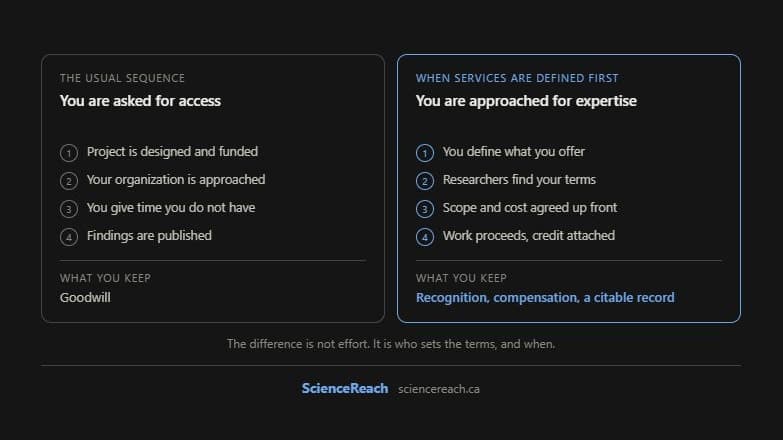
From being asked for a favour to being approached for expertise
Our bias here is obvious, since publishing community knowledge is what we do. But a partnership that leaves your organization with nothing it can use afterward is not a partnership. The difference is not effort. It is who sets the terms, and when.
| The usual sequence: asked for access | Services defined first: approached for expertise |
|---|---|
| Project is designed and funded | You define what you offer |
| Your organization is approached | Researchers find your terms |
| You give time you do not have | Scope and cost agreed up front |
| Findings are published | Work proceeds, credit attached |
| What you keep: goodwill | What you keep: recognition, compensation, a citable record |
There is also a way to stop answering these requests one at a time. Community organizations can sign on to ScienceReach and define their own knowledge services through our Knowledge Service Hub: what you can offer, on what terms, and at what cost. Researchers, students, and policymakers looking for local knowledge come to what you have defined, and your contribution is recognized and compensated instead of absorbed. If you have questions or want help, write to us at info@sciencereach.ca.
