
Dissemination, Knowledge Translation, and Knowledge Mobilization: What's the Difference?
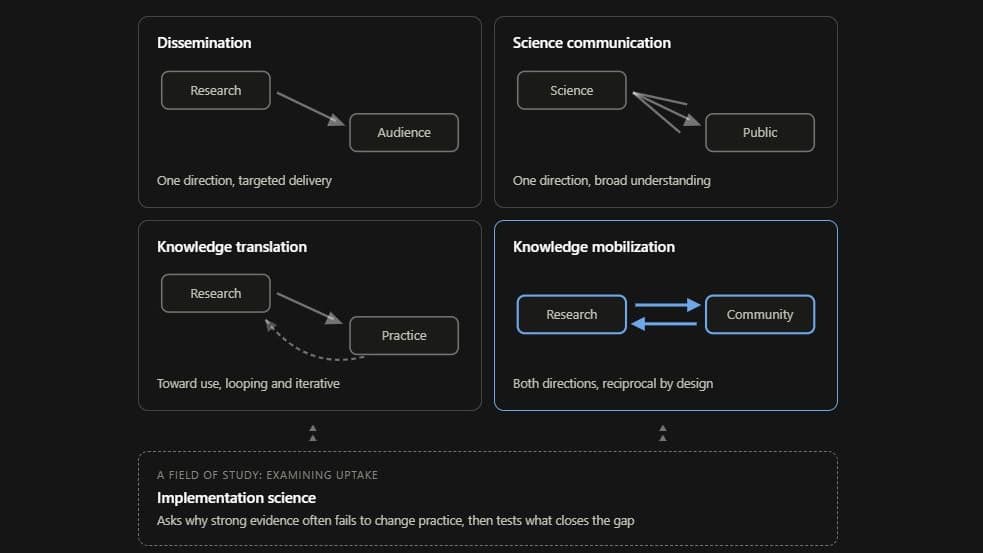
Five terms show up constantly in research and community work, often as if they were interchangeable: dissemination, science communication, knowledge translation, knowledge mobilization, and implementation science. They are related, but they are not the same. The clearest way to tell them apart is to ask two things: which direction does knowledge move, and what is the goal?
Dissemination
Dissemination is the targeted, one-directional delivery of research findings to a specific audience. The goal is to get a known message to the people who can use it. A policy brief sent to decision-makers is dissemination: it flows from producer to receiver.
Science communication
Science communication builds public understanding of and interest in science itself, rather than the uptake of any single finding. It has traditionally been framed as one-directional, from experts to a broad public, though many practitioners now emphasize dialogue and two-way engagement.
Knowledge translation
Knowledge translation is the iterative process of moving research toward real-world use through synthesis, exchange, and ethically sound application. It is not a single handoff. It loops: evidence is adapted, applied, and revisited.
Knowledge mobilization
Knowledge mobilization is reciprocal. Knowledge moves in both directions, and the experience of communities and practitioners counts as knowledge in its own right, not merely as an audience for academic findings. Community organizations are partners in making knowledge, not just recipients of it.
Implementation science
Implementation science asks why strong evidence so often fails to change practice, then tests what closes the gap. It studies the conditions, strategies, and barriers that determine whether an approach is adopted and sustained in real settings.
How they compare
| Term | Direction | What it is for |
|---|---|---|
| Dissemination | One way, targeted | Delivering a finding to a specific audience |
| Science communication | Broad, mostly one way | Building public understanding of science |
| Knowledge translation | Iterative, looping | Turning research into usable form |
| Knowledge mobilization | Two way, reciprocal | Co-producing and moving knowledge with communities |
| Implementation science | Field of study | Explaining and improving uptake |
Why the distinction matters
These words signal who holds knowledge and who sets the terms. Dissemination and one-directional science communication treat the audience as a receiver. Knowledge mobilization treats communities as co-authors. That is the model we publish at ScienceReach: Community Knowledge Publications turn the knowledge held inside community organizations into a citable public record.
